About Us
Contrary to popular belief, Lorem Ipsum is not simply random text. It has roots in a piece of classical Latin literature from 45 BC, making it over 2000 years old.
Get a free quote
Reverse Osmosis Plant
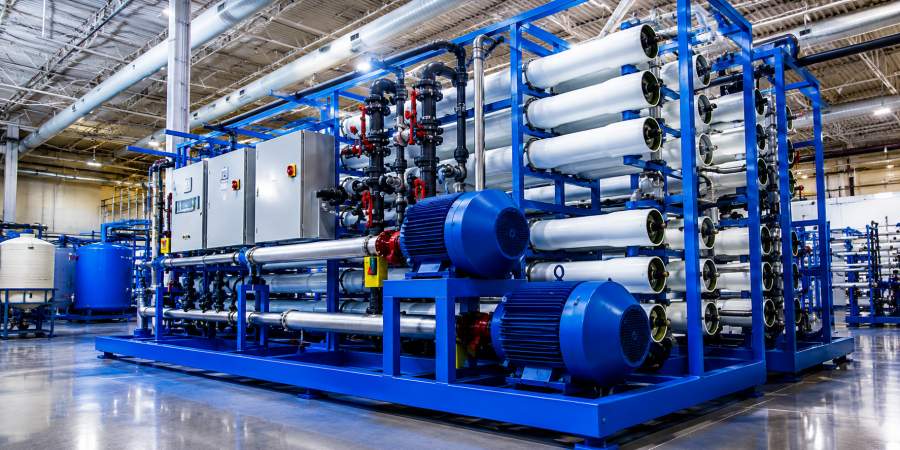
Reverse Osmosis (RO) Plants
Reverse Osmosis (RO) is an advanced membrane-technology filtration method that removes many types of large molecules and ions from solutions by applying pressure to the solution when it is on one side of a selective membrane. The result is that the solute is retained on the pressurized side of the membrane while the pure solvent passes to the other side.
To be selective, this membrane prevents large molecules or ions from passing through its pores while allowing smaller components (such as the solvent) to flow freely. Reverse osmosis is widely used to purify water and remove dissolved salts and other impurities, significantly improving the color, taste, and physical properties of the fluid.
Principle of Reverse Osmosis
Osmosis is a natural process. When two liquids of different concentrations are separated by a semipermeable membrane, the fluid naturally moves from low to high solute concentrations to reach chemical potential equilibrium. Solvent moves across the membrane to equalize the concentration difference between the compartments.
Formally, Reverse Osmosis is the process of forcing a solvent from a region of high solute concentration through a semipermeable membrane to a region of low solute concentration by applying external pressure in excess of the natural osmotic pressure. The specialized membranes used in RO feature a dense layer in the polymer matrix where the precise separation occurs.
Key Advantages
- Active Contaminant Rejection – Actively rejects ions, heavy metals, and dissolved contaminants.
- High-Purity Output – Produces purified water that satisfies the most demanding quality specifications.
- Self-Cleaning Mechanism – Cross-flow membrane action allows continuous self-cleaning during operation.
- High-Pressure Efficiency – Driven by robust high-pressure pumps to force fluid through fine membrane pores.
- Comprehensive Removal – Capable of rejecting bacteria, salts, sugars, proteins, suspended particles, dyes, and organic constituents.
- Versatile Molecular Weight Separation – Operates effectively across a wide range of molecular weights.
Key Applications
Reverse Osmosis technology serves a broad array of industrial, commercial, and commercial utility requirements:
Drinking Water Purification
Used globally in household, commercial, and industrial purification systems to improve water safety, clarity, and taste for drinking and cooking.
Water & Wastewater Purification
Stormwater and collected drain water are purified using RO processors for landscape irrigation, utility reuse, and industrial cooling, addressing freshwater shortages.
Food & Beverage Industry
Offers an economical alternative to heat treatment for concentrating food liquids (e.g., fruit juices like orange and tomato). Avoids thermal degradation of heat-sensitive proteins and enzymes while lowering operating costs.
Car Wash Systems
Low mineral content prevents water spotting on vehicles during final rinsing. Facilitates water recycling in drought-prone areas and reduces load on drying blowers.
Hydrogen Production
Provides high-purity feed water for small-scale hydrogen electrolysis, preventing mineral scaling on electrode surfaces.
Reef Aquariums
RO and Deionization (RO/DI) systems filter tap water to remove chlorine, chloramines, copper, phosphates, and nitrates—preventing toxic conditions and algae blooms in delicate marine ecosystems.
What We Offer
Customized RO / UF Plants
We offer an extremely reliable and simplified range of customized RO & UF Plants. Engineered to be user-friendly, durable, and aesthetically superior, our plants come in capacities ranging from 200 LPH to 50,000 LPH (and higher for larger industrial needs). Featuring well-engineered pretreatment and automated PLC/Controller integration, they are available in both Economy and Premium configurations.
Cabinet Type Packaged Systems (RO / UF)
We supply fully automatic Cabinet Type RO filtration plants packaged inside standardized, compact enclosures. The precision equipment and operating components are safely enclosed in an MS powder-coated box for a clean footprint and protection. Typical capacities range from 50, 100, 200, 500, to 1,000 LPH, with smaller custom configurations available upon request.