About Us
Contrary to popular belief, Lorem Ipsum is not simply random text. It has roots in a piece of classical Latin literature from 45 BC, making it over 2000 years old.
Get a free quote
Demineralization Plant
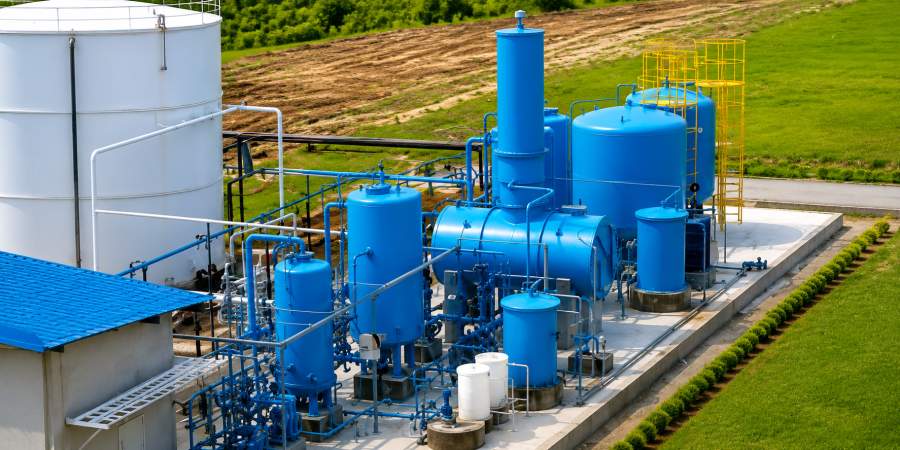
Demineralization (DM) Systems
Demineralization is the process of removing mineral salts from water by using the ion exchange process. Demineralised water is water completely free (or almost) of dissolved minerals as a result of distillation, deionization, membrane filtration (reverse osmosis or nanofiltration), electrodialysis, or other advanced technologies.
Also known as Deionized Water, demineralized water has had its mineral ions removed. Common ions present in raw water include cations such as sodium, calcium, iron, and copper, alongside anions such as chloride, sulphate, and nitrate. Deionization is a physical process that uses specially manufactured ion exchange resins providing active sites for the replacement of mineral salts with water-forming hydrogen ($H^+$) and hydroxyl ($OH^-$) ions.
Because the majority of water impurities are dissolved salts, deionization produces high-purity water generally similar to distilled water—rapidly and without scale buildup. Operating on the principles of ion exchange, degasification, and polishing, DM water systems find widespread application across steam generation, power plants, process industries, and cooling utilities.
Principle & Process of Deionization
Raw water is passed through two small polystyrene bead-filled resin beds. Cations are exchanged with hydrogen ions in the first bed, while anions are exchanged with hydroxyl ions in the second bed. Ion exchange is a rapid and reversible process where impurity ions in feedwater are replaced by ions released by the resin, which is periodically regenerated to restore its original ionic capacity.
Common Water Ions
-
Cations: Calcium ($Ca^{2+}$), Magnesium ($Mg^{2+}$), Sodium ($Na^+$), Potassium ($K^+$)
-
Anions: Chloride ($Cl^-$), Bicarbonate ($HCO_3^-$), Nitrate ($NO_3^-$), Carbonate ($CO_3^{2-Static}$)
Ion Exchange Resins
-
Cation Resin: Releases $H^+$ ions in exchange for impurity cations.
-
Anion Resin: Releases $OH^-$ ions in exchange for impurity anions.
Deionization Configurations
Depending on water quality requirements, deionization can be implemented through two primary configurations:
1. Two-Bed Deionization: Consists of two distinct vessels—one containing cation-exchange resin in hydrogen ($H^+$) form and the other containing anion resin in hydroxyl ($OH^-$) form. Water first flows through the cation column (exchanging cations for $H^+$) and then through the anion column (exchanging anions for $OH^-$), which combine to form pure water ($H_2O$).
2. Mixed-Bed Deionization: Cation and anion exchange resins are intimately mixed in a single pressure vessel. This intimate mixture acts like a lengthy series of two-bed plants in sequence, yielding exceptionally high-purity water. Mixed-bed units are typically used as polishers following two-bed plants or Reverse Osmosis units.
Portable / Mini-DM Water Treatment Plant
Designed for smaller-scale applications using high-grade municipal tap water ($TDS < 100\text{ ppm}$), our compact mini DM plant delivers quick, reliable mineral-free water with zero power consumption.
Mini DM Plant Specifications (Model: eDM-5)
-
Flow Rate: 50 to 80 Liters/hr
-
Footprint: Ultra-compact ($1\text{m} \times 1\text{m}$ footprint)
-
Power Requirements: NIL (Minimum inlet pressure: $0.5\text{ kg/cm}^2$)
-
Output Quality: $TDS < 10\text{ ppm}$ ($500\text{ Liters}$ yield at $100\text{ ppm}$ feed TDS)
Major Industrial Applications
- Power & Energy Generation – High-pressure boiler feed water conditioning and turbine protection.
- Pharmaceutical & Healthcare – High-purity process water for manufacturing and laboratories.
- Automobile & Battery Manufacturing – Battery topping, plating, and surface treatment utilities.
- Chemical & Process Industries – Chemical synthesis, formulations, and rinse operations.
- Textiles, Breweries & Food Processing – High-quality process inputs without mineral interference.
Demineralization Solutions We Offer
We design, manufacture, and export a complete spectrum of technically advanced Demineralization Water Treatment Plants customized to industrial and municipal needs:
- Water Softeners & Base-Exchange Units
- Industrial Two-Stage & Multi-Stage DM Plants
- Mixed Bed Demineralisers & Cation Polishers
- Degasifiers & CO2 Stripping Towers
- Manual, Semi-Automatic & Fully Automatic PLC/SCADA Plants
- Portable / Mini DM Units for Laboratories & Commercial Use